
Understanding Diameters
Diameters
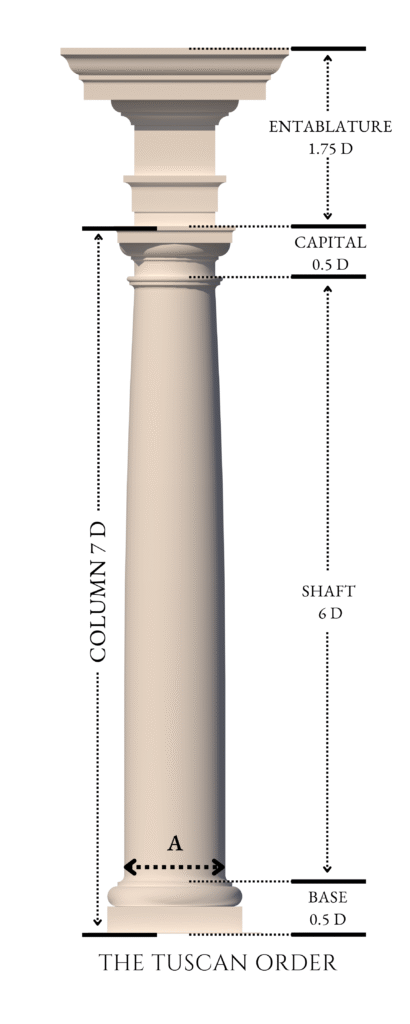
The Diameter, sometimes called a module, refers to the width of a column’s shaft at its base (point A). Diameters are used to define the proportions of the rest of the Order, such as the height of the capital and entablature, and even the rest of the building, including column spacings and door sizes. This system ensures the whole structure remains proportional to itself.
Minutes
A Minute is a simple fraction, equal to 1/60th of a diameter. For example, 45 minutes equals 0.75 diameters. Historically, this unit has helped architects proportion finer details, such as the sizes of mouldings in entablatures or column bases.
- 1 Diameter always refers to 60 minutes.
- Abbreviations are used: D = Diameter, M = Minutes.
Example
1) In the Tuscan Order to the right, let us assume it used around a porch that is 3.15 meters tall. Adding the 7-diameter column height to the 1.75-diameter entablature height, gives a total of 8.75 diameters for the total porch height. Dividing the 3.15m by 8.75 results in a base diameter of 36cm.
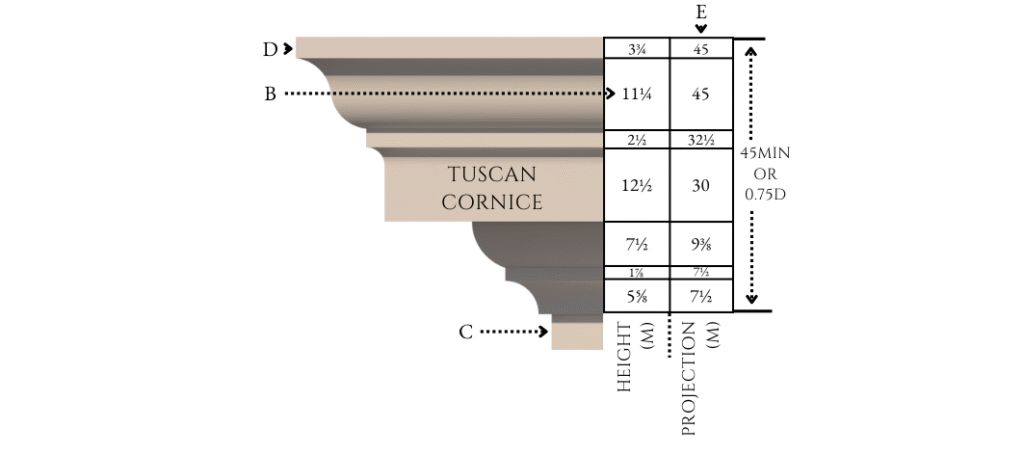
2) This also means that each minute in the Tuscan cornice below equals 0.6cm (36 divided by 60 = 0.6). As the cyma recta (point B) is 11.25 minutes tall, using our calculated value of 0.6cm per minute, we know the cyma recta is therefore 6.75cm tall. Naturally, the same logic applies when using feet and inches, and for the other Orders.
Height & Projection
- The diagram to the right is how the Orders are typically proportioned.
- The Heights indicate how tall each individual moulding is. This are non-cumulative – point B represents only the height of the cyma recta.
- Projections show how far each element extends outward from the edge of the frieze (point C). These measurements are cumulative – point D projects a total of 45 minutes outward from point C, as noted at point E.